

You design an Asian restaurant kitchen around heat, speed, and tight station flow by putting the wok at the center of prep, storage, and plating. A gas burner gives you the fastest live response and real wok hei, while induction gives strong recovery with less energy waste. Keep cookware magnetic, hood seize strong, and cleanup close by, so each order moves fast without steaming or chaos. If you keep going, you’ll see how each setup fits.
Key Takeaways
- Place the wok station in a tight prep-to-cook-to-plating flow to reduce wasted steps and keep dishes moving fast.
- Design wok geometry and heat source together so the pan hugs the flame or coil for strong searing and quick heat recovery.
- Choose gas, induction, or electric based on output needs, but ensure the wok is compatible and can reach high heat quickly.
- Add nearby rinse, storage, and landing zones so cooks can reset stations between orders without breaking workflow.
- Use strong ventilation, front overhang capture, and grease filtration to control smoke, steam, and fire risk.
What Makes a Wok Station Work?
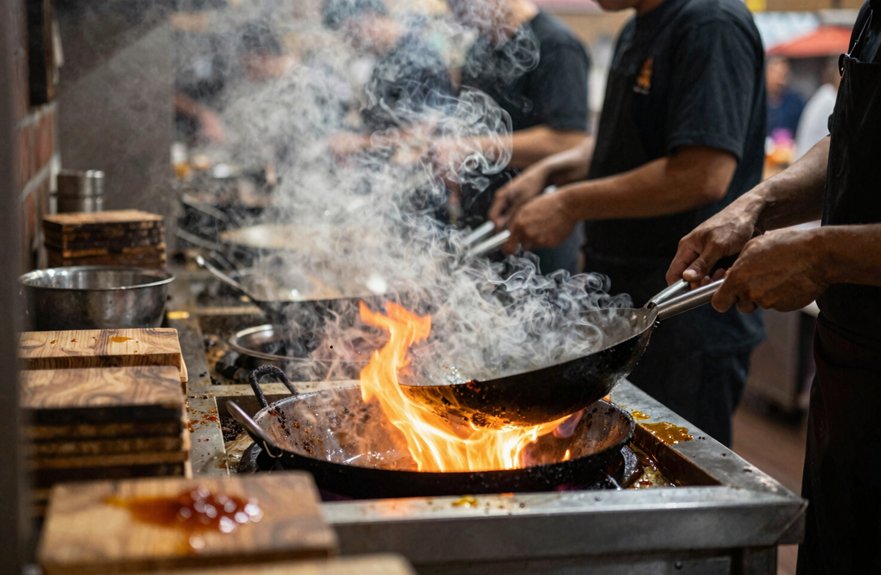
A wok station works best when heat, speed, and layout all support each other, because the whole point is to keep food moving fast enough that it sears instead of steaming.
You need wok geometry that hugs the flame or coil, so the pan sits close and the center stays hot.
Strong heat recovery speed lets you add a batch, toss it, and keep going without losing the sizzle.
Use station zoning to put prep, storage, and the wok in one tight flow, then make quick ingredient loading feel effortless.
Keep a clean rinse workflow nearby, so you reset fast between orders.
Smart utilities placement also matters, since gas, electricity, water, and vent collection should support freedom of motion, not trap you in a clumsy kitchen.
Why Gas Wok Burners Still Feel Fastest?
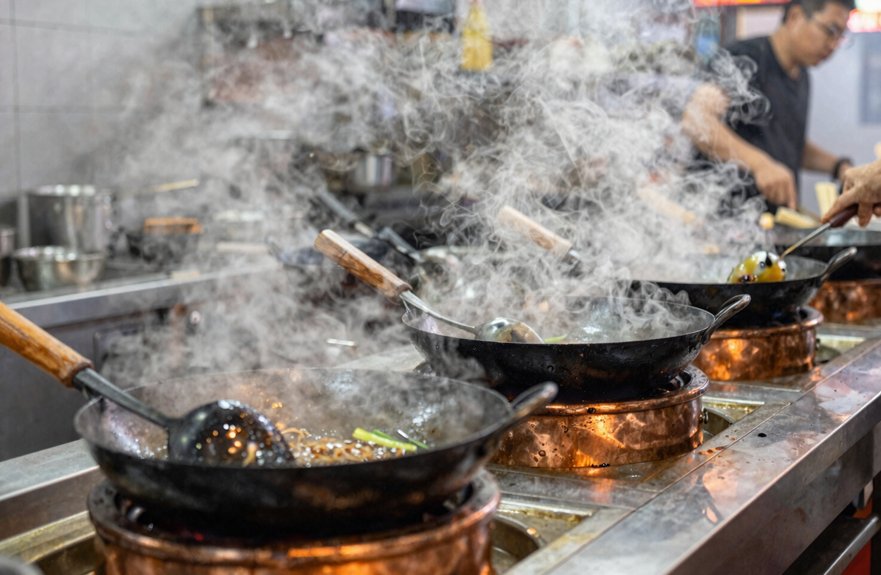
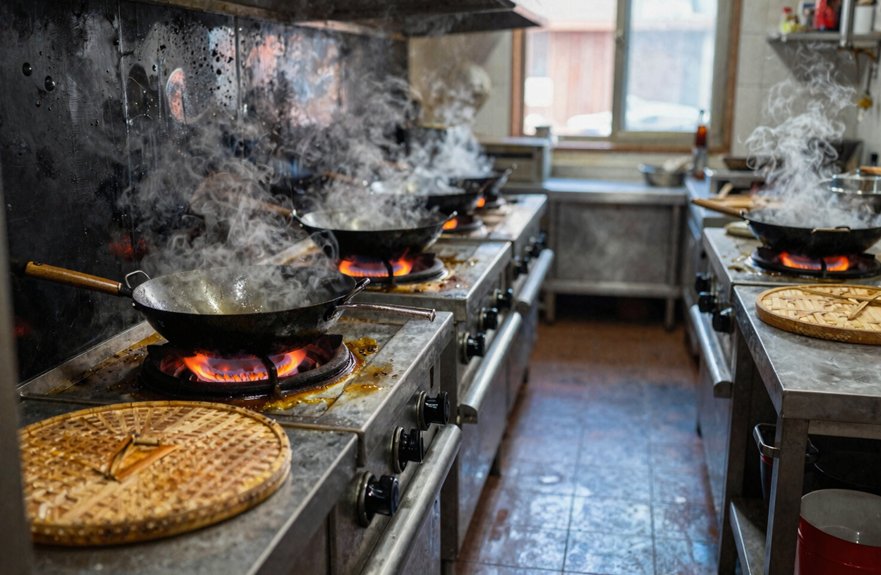
You feel gas wok burners move fast because the open flame hits high heat right away, wraps the wok’s curved sides, and gives you that quick sear chefs call wok hei.
When you turn the flame up or down, it responds almost instantly, so you can push hard for browning and ease off just as quickly, without waiting around.
That sharp control, plus the strong heat at the pan’s surface, is why gas still feels like the speed champion in many busy kitchens.
Open Flame Response
Because gas wok burners use an open flame, they can hit roughly 800–1000°F and respond almost at once when the cook turns the knob, which is why many chefs still call them the fastest-feeling option in a busy Asian kitchen. You get instant control, so your food keeps moving without losing heat.
That freedom supports quick searing, steady browning, and confident pacing. For combustion safety, you still need strong ventilation to keep carbon monoxide and grease fumes in check.
- You can raise heat fast.
- You can lower it just as fast.
- Flame stability helps with heat zoning.
- The wok stays lively, not sluggish.
That open flame wraps the pan, so your station feels ready when you are, not the other way around.
Wok Hei Burst
That instant flame control also creates the burst that chefs call wok hei, the smoky, lightly charred taste that makes stir-fry feel alive.
When you turn a gas wok burner high, you get 800 to 1,000°F heat wrapped around the wok’s curved sides, and that open flame helps with steam control before food can wilt.
You keep wok surface moisture moving, so sauce vaporization happens fast, not lazy, and each toss builds char flavoring instead of a soft boil.
Strong burners in the 15,000 to 100,000 BTU range give you quick heat recovery time, so the pan stays fierce after every handful of ingredients.
That’s why gas still feels free and fast: you steer the fire, keep high temp seasoning sharp, and cook with confidence.
Instant Heat Control
Even with newer tech on the line, gas wok burners still feel the fastest because the flame hits the pan directly and reacts the moment you turn the knob. You get instant heat control, so you can push up to 800–1000°F for a hard sear, then back off for a quick simmer without waiting around.
- That open flame gives you a direct, honest response.
- You can chase wok hei without losing rhythm.
- You keep flavor consistency because each move lands fast.
- You gain temperature stability when you need it most.
Induction can be quick too, but it needs the right wok. Electric usually lags more, so gas still gives you the freedom to cook your way, with fewer delays, more control, and a stronger feel at the station.
How Induction Wok Stations Match Gas Performance?
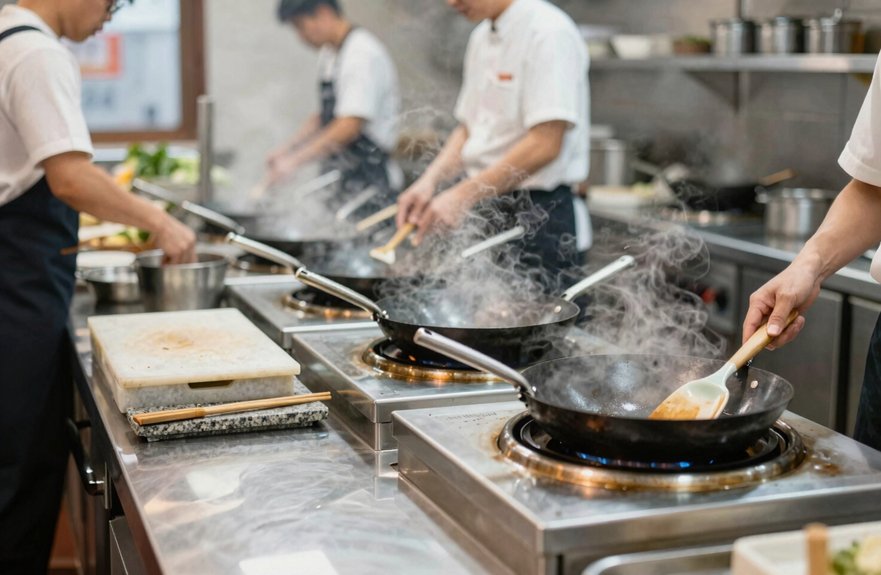
You can get gas-like speed from an induction wok station, because it can bring the pan up to about 800°F in roughly 2 minutes, which keeps your stir-fry pace tight and responsive. It also helps you build strong wok hei while using far less energy, since induction runs around 90–95% efficient and cuts kitchen heat, so your line stays cooler and more comfortable.
The main catch is cookware, since you’ll need a ferrous wok base, but with the right carbon steel wok, you get fast heat, steady recovery, and safer high-output cooking without the open flame.
Gas-Like Heat Response
Although gas has long set the standard for quick wok cooking, a well-built induction wok station can feel surprisingly similar in real kitchen work because it heats the wok directly and responds fast when you need it to.
You keep control over fermentation timing, marinade absorption, and sauce consistency without waiting around.
In practice, your wok station layout and ingredient staging stay smooth, because the heat bounces back quickly after each toss.
- Rapid recovery after you add food
- About 800°F in roughly 2 minutes
- Strong searing with less wasted energy
- Better simmer control and cooler air for you
With a ferrous wok, you get gas-like freedom, plus lower operating cost and less heat in the kitchen.
High-Heat Wok Hei
High-heat wok hei is where induction wok stations really prove they can stand toe-to-toe with gas. You get the same fierce blast that drives a pan side sear, because induction sends energy straight into the wok instead of wasting it around the burner.
With a good ferrous wok, you can hit that 800°F range fast, then keep moving with tight control as the heat shifts under your wrist. That quick response helps you avoid thermostat cycling that can dull a stir-fry.
You also feel strong surface heat soak, so the wok holds temperature when you toss in noodles, meat, or vegetables.
In practice, you keep the freedom to cook hard and fast, with less waiting and no drama—just a clean, lively sear.
Efficiency And Safety Gains
Beyond matching gas on strength, induction wok stations bring a real edge in efficiency and safety. You get fast thermal recovery, so each toss stays hot, and you can keep your line moving with less fuel waste. Induction runs about 90–95% efficient, while gas wastes far more, so your bills can drop 40–50%.
- No open flame means better staff burn protection.
- Wok detection trims extra strength when the pan lifts.
- Less room heat improves ventilation placement and comfort.
- Cleaner controls support incident preparedness and faster response.
You’ll still need ferrous woks, but once you’re set up, you gain freedom from the flare-ups, heat soak, and constant drain that gas can bring.
When Does an Electric Wok Station Make Sense?
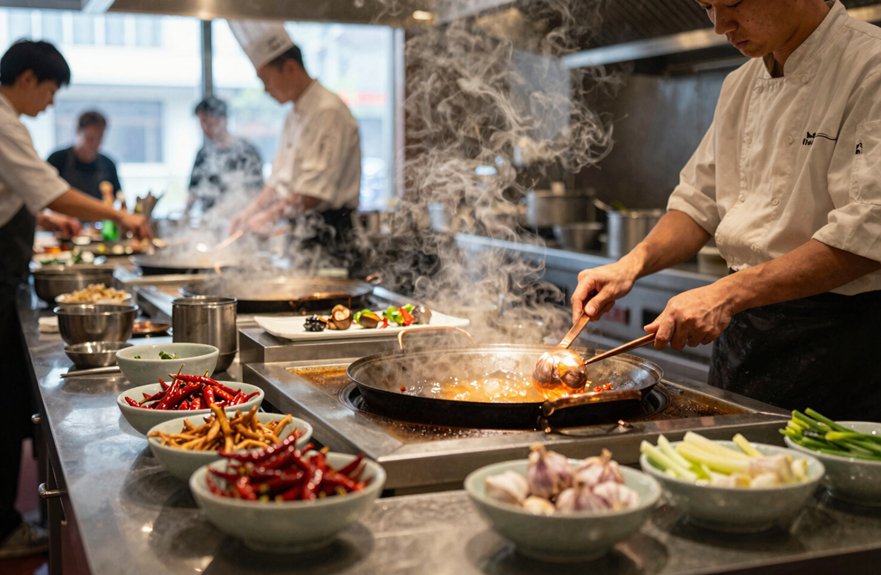
An electric wok station makes sense when you want safer, simpler operation without open flame, especially in kitchens where ease of upkeep matters as much as speed.
You’ll like it when grease management, filter maintenance, operator training, and workflow efficiency all need to stay straightforward, because you won’t deal with gas valves or burners.
It gives you digital heat control in the 200–600°F range, and it fits moderate-volume service where you can plan around a slower warmup.
Expect about five minutes to hit high heat, and a few minutes more for changes, so it’s not built for constant crank-up action.
If you value freedom from heavy ventilation demands more than maximum wok hei, electric can be a smart, steady choice for your line.
Which Wok Station Uses the Least Energy?
If you’re weighing speed, upkeep, and energy use together, induction wok stations usually come out on top for efficiency. You get direct heat, about 90–95% efficiency, so more electricity reaches the pan and less slips away. That freedom matters when you want control over costs and workflow.
- It heats fast, nearly 800°F in about 2 minutes.
- It uses wok detection to cut idle waste.
- It beats gas and electric on insulation efficiency.
- It needs operator training and ferrous wok gear.
Gas runs around 30–35% efficient, and standard electric sits near 50–55%. If your wok is magnetic, induction gives you the leanest energy use in practice, without slowing service.
Why Wok Station Ventilation Matters?
When you run a wok station, you need ventilation that can scoop up thick grease aerosols fast, before they drift onto walls, ceilings, and nearby equipment.
Strong scoop up also helps you stay on the right side of fire-safety rules, since grease that slips into ductwork can build up and raise risk over time.
With the right hood and grease control, you keep the air clearer, the station safer, and the line moving without smoky surprises.
Grease Aerosol Capture
At a wok station, the air moves fast for a reason: high heat, quick tossing, and strong flames create grease-laden aerosols that behave more like a spray than a gentle cloud, so a standard baffle-only hood usually can’t keep up. You need capture that matches the pace, or your turnaround efficiency and menu throughput slip.
- Aim for front overhang capture.
- Use high extraction rates for heavy vapor.
- Choose UV or ESP filtration to break down grease.
- Size airflow to the wok load, often 500+ CFM.
When you trap those tiny oil droplets early, you keep ductwork cleaner, cut buildup, and stay freer to run hard without constant cleanup. It’s a smart setup that gives your line more breathing room and your kitchen more control.
Fire Safety Compliance
Strong grease holds isn’t just about keeping a wok line clean; it’s also a major part of fire safety compliance.
When you run a wok station, you push out dense grease exhaust, so you need high-velocity capture, not a weak standard hood.
Good hood placement, with an extended front overhang and 500+ CFM, helps trap smoke and hot vapor before it escapes.
You also protect code compliance when you use advanced grease filtration, UV systems, or ESPs to neutralize particles before they enter ducting.
That matters because buildup inside the HVAC can ignite fast.
Smart induction safety and strong ventilation both support a freer, safer kitchen, where you control heat at the source and keep your station flow moving without drama, delays, or surprise fire risks.
How Kitchen Layout Cuts Steps in Service?
A smart kitchen layout trims wasted steps by moving food in one clear direction, from receiving to storage, then prep, cooking, and plating, so the team doesn’t keep doubling back during busy service. You gain real freedom when traffic flow mapping and Kitchen queue optimization keep work moving.
With undercounter refrigeration under prep, your mise placement discipline stays tight, because ingredients sit grab-close. Zone raw prep away from plating, and you cut delays from safety rework.
Center the layout on the wok hub, and use service pace control to keep every plate on rhythm.
- Receiving to plating, one lane
- Cold storage under prep hands
- Raw and cooked zones apart
- Steam and soup stations steady
Where Should You Place the Wok Station?
You should place the wok station as the heat hub in your central cooking zone, so ingredients can move from prep to stir-fry fast, without wasting steps or time.
Keep it close to your prep tables and undercounter refrigeration, because wok cooking works best when your mise en place stays right at hand and the pan stays hot.
Set it directly under or in front of a strong vent hood, with the right burner height and utilities, so heat, airflow, and speed all work together instead of fighting each other.
Central Heat Hub
Because the wok station drives the pace of the whole kitchen, it should sit at the center of the heat flow, where ingredients can move in the shortest path from receiving and storage to prep, then into wok or steam cooking, and straight on to plating and service.
- You cut a speed bottleneck before it starts.
- You reduce prep reflow and keep motion clean.
- You let the wok nest low, close to the flame, so heat stays fierce.
- You keep refrigeration, hand-wash, and mise en place nearby, so every batch lands fast.
If you want real wok hei, give the station instant-response high-BTU heat, then place it between raw handling and finished plates. That way, you cook hard, plate right away, and keep service free-flowing without losing heat or momentum.
Adjacent Prep Flow
Once the heat hub is set, the next question is how the wok station connects to the rest of the line. You’ll get the best flow when you place it between prep and plating, so mise en place feeds in nonstop and finished dishes move out fast.
Keep it beside undercounter refrigeration and prep tables for ingredient staging, because cold storage adjacency cuts walk time reduction and protects prep timing when every second matters.
Give raw-meat prep its own zone, separate from the cooked side, and keep the wok in a clear lane that sends food straight to service. A lower counter helps your reach, while nearby sinks make quick rinsing easier.
Put the station where the hood catches heat well, so the line stays smooth, not boxed in.
Vent And Utilities
For the wok station, placement is about more than speed—it’s also about heat control, venting, and clean utility runs that won’t fight each other. Put it under a high-velocity capture hood, keep it close, and let airflow zoning do its job.
- Use strong steam capture so grease and vapor stay contained.
- Keep drain design separate from grease-heavy zones.
- Give gas or induction lines their own utility separation.
- Place the faucet and deep well where the hood can catch rinse splatter.
If you use induction, verify the electrical service can handle the load without forcing extra clearance tricks. Short duct runs help too, since less buildup means less risk and more freedom to cook hard, move fast, and stay in control.
Where Do Steaming Stations Fit?
Where do steaming stations belong in an Asian restaurant kitchen? You’ll place them right after prep, but before wok or pot work, so dumplings, seafood, and rice stay ready for fast plating.
Unlike fierce wok heat, steaming needs steady moisture and quick cycles, so you’ll want commercial pressure or multi-tier units that keep service moving.
Build in efficient drainage and service condensation control, because pooled water can turn crisp baskets into sad little soup bowls.
Good ventilation planning also helps the zone stay clean and calm.
Set the layout for assembly-line flow, from receiving to service, and use tiered storage and handling to cut carry distance during a dim-sum rush.
That way, your team moves freely, without fighting the steam.
How Do Soup Ranges Keep Broths From Scorching?
After steam-heavy stations keep dumplings and rice moving, the next question is how to hold soups and stocks at a calm simmer without burning them on the bottom. You rely on soup ranges with low-BTU burners, and they give you steady heat instead of the melt-to-boil swing that scorches a pot.
- Watch soup ladling technique so you don’t stir up sludge.
- Plan batch volume planning to match burner output.
- Respect burner placement spacing to avoid rebound heat.
- Notice insulation impact, since well-built pots hold warmth better.
With broth salting timing, you season near the end, then taste again. Dedicated soup burners keep the base gently warm, and that protects stock cooling safety while you stay free to serve fast, smooth bowls.
What Cookware Works With Induction Wok Stations?
What cookware actually works on an induction wok station?
You need ferrous cookware, meaning it must contain iron so wok magnetism can spark in.
A carbon steel wok, especially a pre-seasoned 14-inch model, usually works right away, and a cast iron base also heats well.
Aluminum and copper won’t heat unless they hide a magnetic layer, so check before you buy.
Because induction sends heat straight into the wok, you can reach high temperatures fast, which helps you move with freedom and speed.
On commercial stations, that matters even more, since 3.5KW countertop and 12KW built-in units expect full compatibility.
If your current pan isn’t magnetic, plan for induction-compatible cookware costs around $50–$150.
Wok detection saves energy only when the wok fits and connects fully.
How Do You Balance Safety, Comfort, and Output?
Once you’ve matched the right cookware to the right heat source, the next step is making sure the kitchen can keep moving fast without wearing people down or raising risk. You can do that by tuning heat, airflow, and station layout together.
When you plan for freedom, you give your team room to work hard without fighting the room.
- Match gas wok heat to strong hoods and tight grease containment.
- Use induction when you want cooler air and steady output.
- Shape stations so cooks reach less and burn less.
- Add drainage and simmer control to stop overflow and scorching.
Respect ventilation limits, and you’ll protect staff, ductwork, and service speed.
With the right setup, comfort isn’t a luxury, it’s part of staying sharp and productive.
Why Do Chefs Still Prefer Gas for Wok Hei?
So why do so many chefs still reach for gas when they want true wok hei? Because you get near-instant energy modulation, flame visibility, and heat that can jump to about 800–1000°F, then drop fast between batches.
That live flame feels like an extension of your hand, so you can read the fire, shape the toss, and keep the center hot even when the setup isn’t perfect.
You’ll still need strong hood design, grease containment, safety interlocks, and solid operator training, since gas throws more room heat and asks more from ventilation.
Careful wok ring placement, burner grate care, temperature calibration, and wok sizing all help you hold that old-school rhythm.
You trade some efficiency for freedom, speed, and the charred flavor that electric often can’t match.
How Do You Choose the Right Wok Station Setup?
Choosing the right wok station setup starts with one simple question: how much wok food do you need to turn out each day, and how fast does it need to move?
If you chase Quick Turnover, size the burner for your volume, then match it to gas, electric, or induction.
- Check Burner Sizing and Heat Consistency.
- Protect Operator Comfort with good reach and airflow.
- Verify Cookware Fit, especially for induction.
- Build a Zoning Layout that supports Cleaning Access.
Place the wok as the hub of Station Workflow, keep raw prep apart from cooked plating, and tuck refrigeration under prep tables.
If you want freedom from slow service, choose a setup that keeps the wok close to the flame or coil, because lifting it kills heat and hurts wok-hei.